
At a glance
- Anything that sticks to a strong magnet is not solid gold.
- Not sticking doesn’t prove a piece is gold. Brass, copper, silver and many fakes don’t stick either.
- Use a strong rare-earth magnet, not a fridge magnet.
- Test clasps on their own. Many have a small steel spring inside.
- It’s the first sort. Then read the stamp and acid test.
Why the magnet test works
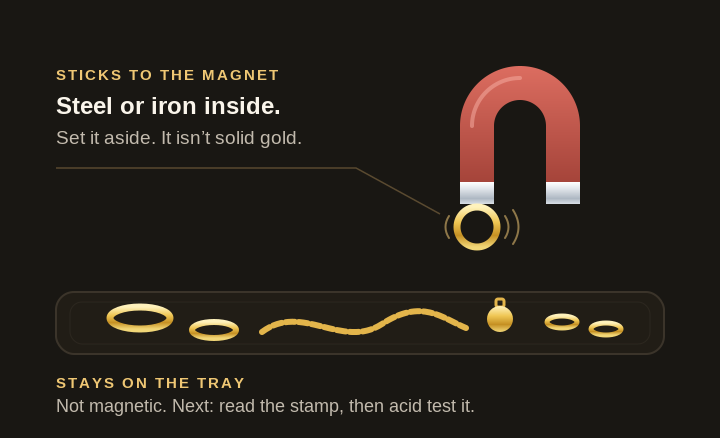
Gold isn’t magnetic, and neither are the silver, copper and zinc it’s mixed with in karat gold. Iron, steel, nickel and cobalt can be. So if a “gold” piece is pulled toward a magnet, there’s a magnetic metal in it: usually a steel base under gold plating, or costume jewelry that was never gold at all.
What you need
- A strong neodymium (rare-earth) magnet. A small block or disc you can hold comfortably is plenty. Fridge magnets are too weak and miss pieces with only a little steel in them.
- A tray or a clear, flat counter, so you can spread the lot out.
- Good light, so you can see a piece shift as well as snap.
As an Amazon Associate I earn from qualifying purchases. On Amazon: YukaBa keychain magnet testers (paid link). The full list is in the gold buyer’s kit.
Rare-earth magnets are strong. They can pinch fingers when they snap together, and they should be kept away from phones, cards and anyone with a pacemaker.
How to do the magnet test
- Spread the lot out. Don’t test a heap. Pieces underneath get missed, and a steel piece can drag a gold one along with it.
- Pass the magnet slowly, close to the pieces. A quick wave over the top misses small pieces and pieces with only a little steel.
- Then check each piece on its own. Hold the magnet against it, or let a chain hang from your fingers and bring the magnet close. Watch for any movement toward the magnet, not only a hard snap.
- Pull out anything that sticks or drags. Set it to one side and don’t price it as gold.
- Test the clasp separately. Spring ring and lobster clasps often have a small steel spring inside, so the clasp can pull while the chain is solid gold. Test the chain away from the clasp before you decide anything.
- Move on to the next checks. Everything that didn’t stick goes on to the stamp and the acid test.
What the result tells you
- It sticks hard: there’s steel or iron inside. It isn’t solid gold.
- A slight pull or drag: something in it is magnetic, such as a steel core, a plated base or a steel part. Slow down and find out which part is pulling before you go further.
- No pull at all: it may be gold. It may also be brass, copper, silver, plated brass or a heavier fake. You don’t know yet.
A magnet only gives you a sure answer one way. If a piece sticks, you know it isn’t solid gold. If it doesn’t stick, all you know is that it isn’t steel.
Why passing the magnet test isn’t proof
Plenty of things that aren’t gold won’t move for a magnet: brass and copper costume jewelry, gold-plated brass, gold-filled pieces, gold-plated sterling silver, and fakes made with heavy non-magnetic metals such as tungsten. A clean pass only means the piece goes on to the next check.
Next, read the stamp and then acid test it. The magnet test is the first, easiest and quickest way to filter out the pieces that aren’t good, and that’s all it is.
Mistakes new buyers make
- Rushing. One wave over the pile isn’t a test. Take your time and check piece by piece.
- Using a weak magnet that misses pieces with only a little steel in them.
- Trusting a pass. A piece that didn’t stick has only passed the first check.
- Writing off a whole chain because the steel spring in its clasp pulled.
Checks on checks. Every piece gets the magnet, a close look at the stamp and an acid test before you pay for it. Most money at the counter is lost by rushing, not by bad luck.