
At a glance
- It has to say sterling: STERLING, STER, 925 or .925.
- EP, EPNS, “silver plate” and nickel silver mean little or no silver. Don’t pay sterling for them.
- Knives usually have stainless blades and weighted handles. Candlesticks are weighted too.
- Run the magnet test, and look for green spots or brass showing through.
- Melt value = weight in grams × 0.925 × silver spot per gram.
Look for the sterling stamp
Sterling silver is 92.5% silver. A piece has to be clearly stamped as sterling, or carry a mark that plainly means sterling. Look on the back of flatware handles, under the base of bowls, trays and candlesticks, and on jewelry clasps.
Means sterling
- STERLING
- STER
- 925 or .925
- A lion hallmark on British silver
Plated, or no silver at all
- EP, EPNS, EPBM
- SILVER PLATE, SILVERPLATE
- QUADRUPLE PLATE
- NICKEL SILVER, GERMAN SILVER, ALPACA (no silver at all)
- “Sheffield” with no sterling mark
Some older silver is a different purity: 900 or COIN is 90% silver, and 800 is 80%. Price those at their own purity, not as sterling.
Don’t pay sterling for silver plate
Silver-plated pieces have a thin coat of silver over copper, brass or nickel silver. There are ways to recover the silver from plate, but there’s very little of it, so be wary of plate for now. The rule is simple: never pay sterling money for plated pieces.
A famous maker’s name isn’t a purity mark. Many well-known flatware makers sold both sterling and plate, so look for the word sterling or 925, not the brand.
Weighted pieces: knives and candlesticks
Knives
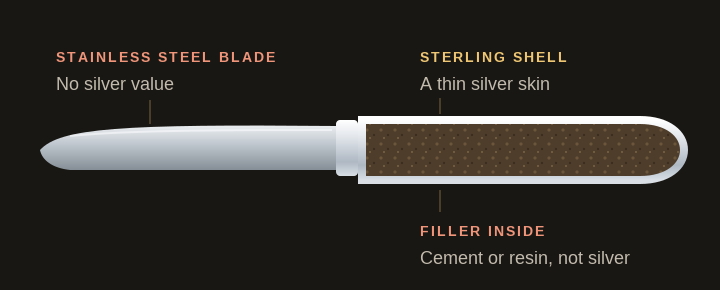
In most sterling flatware sets the knives have stainless steel blades and hollow handles. Only the handle is sterling, and it’s a thin shell filled with cement or resin to give it weight. Weigh knives separately from forks and spoons, and don’t price them on their full weight.
Candlesticks
Candlesticks and candelabra are weighted. The base is filled with pitch, plaster or cement, and there’s often a threaded rod through the middle. Many are marked WEIGHTED or REINFORCED next to the sterling stamp. The silver itself is thin sheet, so the real silver weight is a small part of what the scale says.
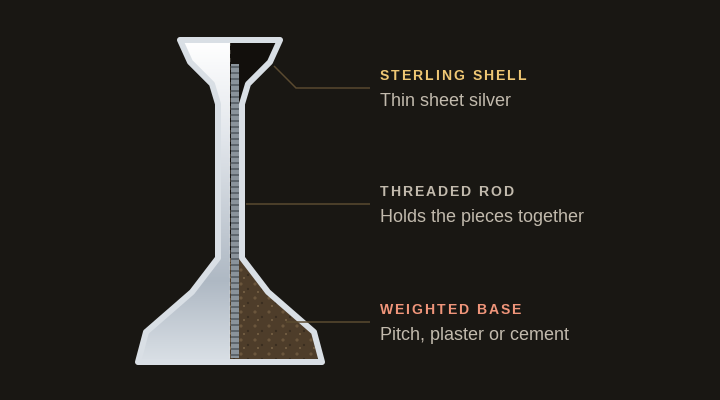
You can break a weighted piece down with a hammer to get to the metal. Expect a lot less silver than the scale showed with the filler in, and wear eye protection while you do it.
Hand mirrors, brushes and pieces with glass liners or wooden handles are mostly not silver either. Take those parts off or weigh them out.
More checks before you buy
- The magnet test. Sterling isn’t magnetic. If it sticks, there’s steel underneath. See the magnet test guide.
- Green spots. Green bits, especially in corners and worn edges, point to copper. Sterling tarnishes dark gray or black, so green, or brass or copper showing through where a piece rubs, suggests plating over base metal.
- Plating wear. Look at the high points and edges, where plating wears through first.
- The acid test. Use silver testing acid and the color chart on the bottle, in a spot that won’t show. The acid test guide covers safety.
It’s checks on checks: the stamp, the magnet, a close look, then the acid. Make everything right before you buy.
How to weigh sterling
- Weigh in grams on a digital scale you trust. Precious metals are priced by the troy ounce (31.1035 grams), not the ordinary ounce.
- Sort before you weigh: forks and spoons together, knives separately, and hollow or weighted pieces on their own.
- Leave out what isn’t silver: stainless blades, filler, glass, wood and felt.
As an Amazon Associate I earn from qualifying purchases. On Amazon: the A&D EK-600i balance (paid link), 600 g × 0.1 g, or for single small pieces the American Weigh Scales 100 g pocket scale (paid link). The PuriTEST six-solution kit (paid link) includes silver acid. The full list is in the gold buyer’s kit.
How to work out melt value
melt value = weight in grams × 0.925 × (silver spot per troy ounce ÷ 31.1035)
For example, 63 g of sterling forks and spoons at a silver spot price of $53 an ounce:
- Price per gram: $53 ÷ 31.1035 = about $1.704
- Pure silver: 63 g × 0.925 = about 58.28 g
- Melt value: 58.28 g × $1.704 = about $99.30
A buyer then pays a share of melt value to cover refining and their costs. To run your own numbers, open the scrap gold and silver calculator, choose Silver, and pick .925 sterling.
Mistakes new buyers make
- Paying sterling for silver plate.
- Pricing knives and candlesticks on their full weight.
- Trusting a brand name instead of a sterling mark.
- Rushing. Slow down and check every piece.
Checks on checks. Every piece gets the magnet, a close look at the stamp and an acid test before you pay for it. Most money at the counter is lost by rushing, not by bad luck.